Does Your Hanbok Get You Into Gyeongbokgung for Free?
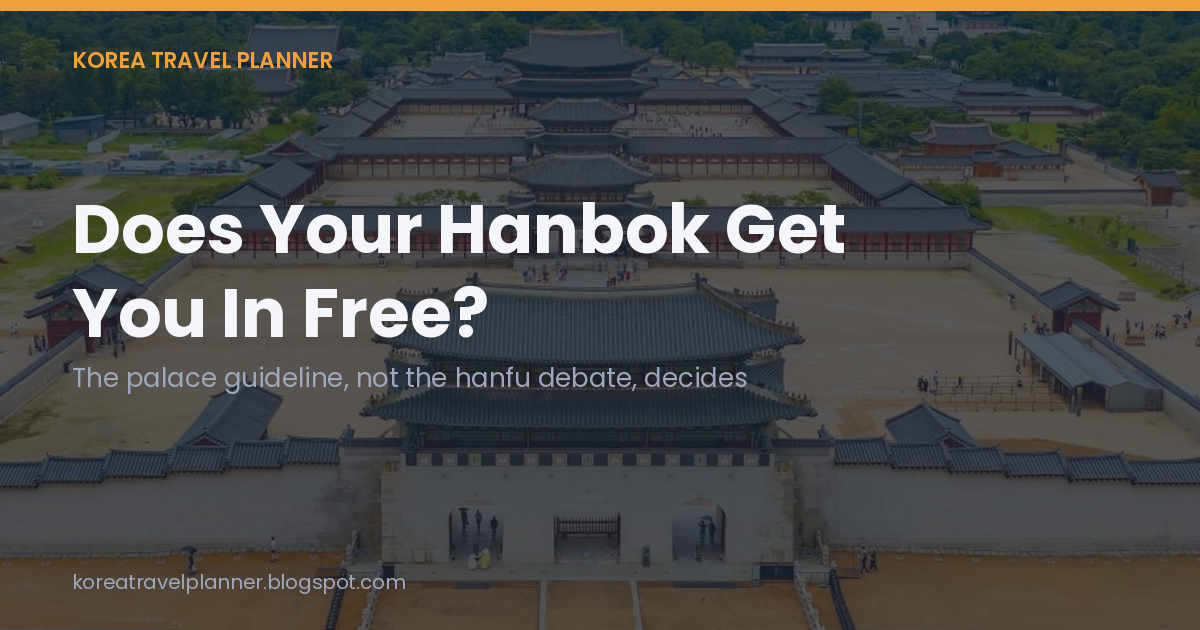
Wear a jeogori on top and a chima or baji on the bottom to Gyeongbokgung and the ₩3,000 (about $2.20) ticket disappears — 2.07 million people did exactly that across Seoul's five royal sites in 2025, up from around 540,000 in 2022, according to Hankook Ilbo. This week a wave of Chinese hanfu videos filmed at the same palace gates put that free-admission rule back in the spotlight, and it's worth knowing exactly what that rule says before you rent an outfit.
The Rule, In Plain Words
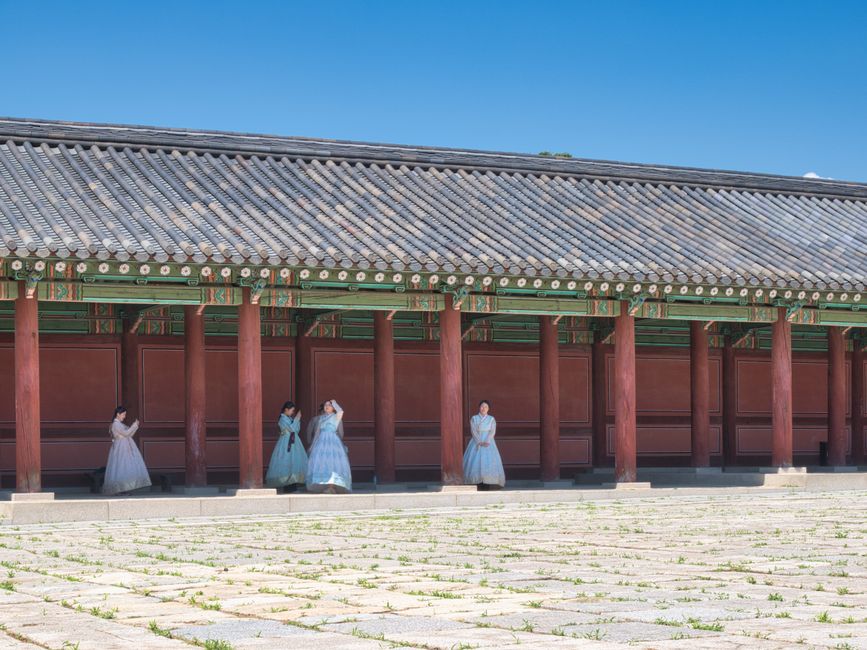
The Royal Palaces and Tombs Center's own guideline page is specific, and it's not about nationality. Both a top and a bottom, worn together, is the whole test: a jeogori with an overlapping collar (여미는깃), paired with a skirt or a pair of pants shaped like traditional sapok trousers. The guideline explicitly covers foreign visitors too — the policy exists partly to spread hanbok internationally, not to gatekeep it.
What fails the test: a jeogori worn over jeans, a hanbok skirt paired with a plain t-shirt, or a durumagi-style overcoat worn alone with nothing underneath. One-piece hanbok-style dresses don't count either — a jeogori and a separate skirt have to actually be there, not implied by a single garment. None of this has anything to do with hanfu specifically. It's the same top-and-bottom test whether you rented from a shop on Hyoja-ro or brought your own outfit from home.
This Week's Hanfu Videos, and What They Don't Change
Videos of tourists posing in bright hanfu — the wide-sleeved, side-fastened style of traditional Chinese dress — at Gyeongbokgung, Gwanghwamun Square, and Myeong-dong have been circulating on Instagram and TikTok since late August, and The Korea Herald and Seoul Economic Daily both covered fresh flare-ups this week. The reaction from Korean commenters ties straight back to China's Northeast Project, the early-2000s research initiative that Korean scholars have long criticized for folding ancient Korean kingdoms into Chinese history, plus a 2021 episode where Baidu's own encyclopedia described hanbok as descending from hanfu.
Sungshin Women's University professor Seo Kyoung-duk, who's been the loudest voice on this, told Seoul Economic Daily he thinks the surge of Chinese social media users pushing the "hanbok came from hanfu" claim comes from "a sense of cultural inferiority" now that K-pop and K-dramas have made Korean culture, in his phrasing, "the central culture of Asia." Not everyone agrees it's that loaded — one commenter under the viral clips pushed back that a tourist "simply wore traditional clothing and took some photos," and reading a political statement into a photoshoot is a stretch.
For a visitor, the practical takeaway is narrower than the headlines: hanfu was never eligible for free admission in the first place, dispute or no dispute, because it fails the jeogori-plus-bottom test on its own terms. Nothing about this controversy changes what counts as hanbok at the ticket booth. It just means more people are paying attention to the difference this month.
Where to Rent One
Rental shops cluster on Hyoja-ro and the side streets running off Gyeongbokgung's main gate, plus a second cluster near Anguk Station for the Bukchon side of the palace. A standard four-hour rental with dressing help runs ₩15,000–25,000 (about $11–19); themed or premium sets with better fabric go for ₩45,000–80,000 (about $34–60). Add ₩5,000–10,000 (about $4–7) if you want your hair styled to match. Most shops open around 9 a.m. and close by 7 p.m., seven days a week.
Book ahead if you're going in spring or fall — May, June, September, and October are when popular shops near Anguk Station sell out their morning slots by 11 a.m., according to Seoulscope's rental guide. Show up by 9:45 and you'll beat the first tour buses in.
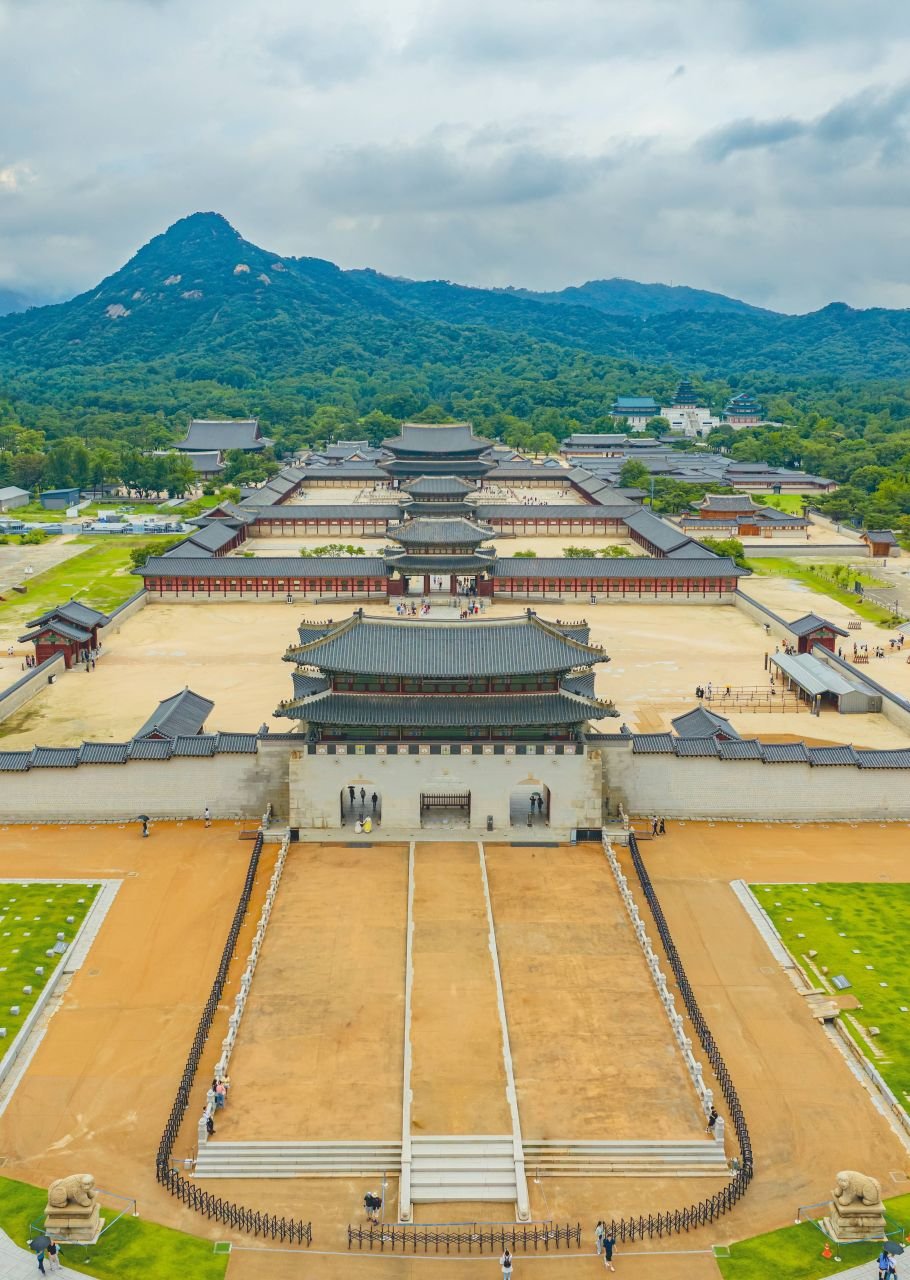
You still have to collect a physical "zero-won" ticket at the booth even though nothing's charged — don't just walk past the counter in your rented outfit assuming the hanbok itself is the ticket.
What the Ticket Booth Checks
Staff aren't measuring your outfit against a checklist of Chinese versus Korean design elements — they're checking for the jeogori-plus-bottom combination, full stop. A modern "fusion" hanbok with a zipper instead of a tied goreum, or pants with elastic instead of a traditional waistband, still passes as long as the silhouette holds. Since July 2019, men can wear a skirt hanbok and women can wear pants hanbok and still qualify, per The Asia Business Daily's breakdown of the palace guideline — gender doesn't factor into the rule either.
If you're renting from any of the shops right outside the palace, you're getting genuine hanbok by default; the confusion in the news this week is about a small number of visitors deliberately choosing hanfu, not about rental shops mislabeling their inventory. You don't need to worry about accidentally renting the wrong thing.
Skip the rental entirely if all you want is the palace itself — the ₩3,000 ticket is cheap regardless. But if the hanbok photos are part of why you're going, book the outfit a day ahead, wear the flat shoes the shop gives you (the courtyards are gravel and uneven stone), and get there before the crowds show up in matching pastel sets around 10 a.m.
Either way, that ₩3,000 was never really what this week's argument was about.
This is a running news series, not a one-off post — new stories go up twice a day, roughly 7am and 7pm Korea time.
More Korea coverage from our network: Hallyu Now · K-Sports Global · Korean Table · Seoul Skin Notes


Comments
Post a Comment