T-money vs K-Pass: Which Seoul Transit Card Should Tourists Buy
You've probably run into both names while researching this trip: T-money, and K-Pass. Only one of them is built for a visitor, and it isn't the one getting more headlines in Korea this month.
K-Pass isn't a card you buy at a kiosk. It's a national refund program, and Korean bank pages describing it spell out the mechanics: ride public transit 15 or more times in a calendar month and you get 20% of your fares back the following month, rising to 30% for people 19–34 and 53% for low-income riders, capped at 60 trips. To even open an account, multiple guides written specifically for foreigners agree on the same three requirements: a Korean-issued bank card, a Korean mobile number, and, for anyone who isn't a citizen, an Alien Registration Card tied to an actual address here. A one-week trip on a tourist visa clears none of that. As one of those guides puts it plainly, short-term visitors "cannot register for K-Pass under any version of the system."

Why K-Pass Doesn't Work for a Short Trip
The timing makes the confusion worse. Seoul just retired its old 30-day Climate Card. Recharging stopped August 31, and the last day anyone could ride on a prepaid one is September 29. In its place: a new program called Climate Pass, which launched September 1, five days before this post, running on the same national K-Pass backbone described above. It's a real change if you live here. It changes nothing for you, because the residency requirement didn't go anywhere — it just moved to a new name.
So the real question isn't T-money versus K-Pass.
It's T-money versus the one transit product Seoul still sells to someone with no Korean ID at all: the Climate Card's short-term pass, which survived the shutdown untouched.
What a T-money Card Costs You, Ride by Ride
Start with the plain option, because it's the default for a reason. A basic T-money card runs ₩2,500 to ₩4,000 depending on the design, and every subway station and convenience store sells one. Load it with cash or, at the newer kiosks across Lines 1–8, a foreign Visa or Mastercard.
Every ride with the card costs ₩1,550 for an adult, covering the first 10 kilometers, with ₩100 added per additional 5 kilometers, per Seoul's own fare page. Pay cash instead of tapping a card and a single subway ticket runs ₩1,650, confirmed the day the current fares took effect in June 2025, and the number hasn't moved since. That ₩100 gap on every ride is the whole reason nobody pays cash here.
When you leave, hand the card back at a convenience store and you get the balance minus a ₩500 handling fee, capped at ₩20,000 through GS25 or 7-Eleven and ₩30,000 through CU or emart24. If what's left is smaller than one base fare, you get all of it back with no fee taken out. The full breakdown is here. Or skip the refund line entirely. The physical card itself has no expiration. Wikipedia's spec sheet lists "credit expiry: none", so a card with ₩3,000 sitting on it is worth throwing in your bag for the next trip, not cashing out for less than the price of a coffee.

Seoul's Short-Term Pass Is the Real Competitor
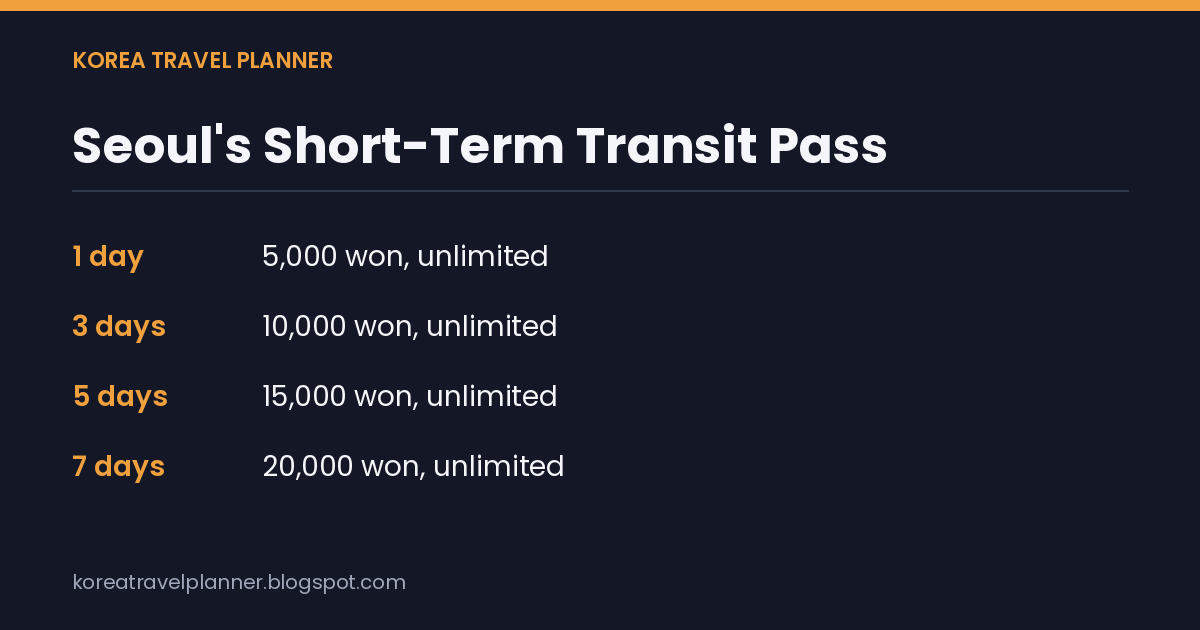
This is the card that competes with the T-money math above. Seoul sells unlimited-ride passes in five lengths: ₩5,000 for one day, ₩8,000 for two, ₩10,000 for three, ₩15,000 for five, and ₩20,000 for seven, per the city's own page. Foreigners get the physical-card version only, since there's no app option without a Korean bank account, and that adds a one-time ₩3,000 card cost on top, bought with cash or a foreign card at a Line 1–8 ticket machine or a convenience store.
Do the arithmetic against the ₩1,550 fare and the break-even point is exactly four rides. Three subway or bus taps in a day cost ₩4,650, still under the ₩5,000 day pass. A fourth tap pushes you to ₩6,200, and the pass has already paid for itself. Stretch that across three days and it's an even easier call: the ₩10,000 three-day pass only needs about 6.5 total rides across those three days to break even, a little over two a day, which is a low bar for anyone sightseeing rather than sitting in a cafe.

Where the Pass Stops Working
Seoul's short-term pass covers most of the subway network inside the city plus every city and village bus, according to the transit authority's own usage guide, but three things are flatly excluded: the privately-run Sinbundang Line, the GTX regional express, and any bus not licensed by Seoul, which rules out Gyeonggi and Incheon routes along with airport limousine buses. There's exactly one workaround built in: you can ride the regular, non-express Airport Railroad train out to Incheon Airport and exit there, or ride Line 7 out to Kkachiul and exit, but you can't board a train back into the city from either spot on the same pass.
Practically, that means one thing: if your itinerary includes a day trip to Everland, Nami Island, or the airport partway through your stay, that one day breaks the pass's logic. Buy the shorter pass length that covers your city days only, and pay per ride in cash or a spare T-money card on the day you leave the zone. Trying to stretch a five-day pass across a trip that includes two out-of-zone days isn't saving you anything on those two days — you're paying for unlimited rides you can't use.
So Which One Should You Buy?
If your trip is short and light on transit (a couple of neighborhoods, mostly walking, maybe three taps a day), plain T-money wins and you never think about it again. If you're covering ground the way most first-time visitors do, palace one morning, a market across town that afternoon, dinner in a third neighborhood, buy the pass that matches your city-days and carry a second, ordinary T-money card for the one day that leaves Seoul.
Keep both cards, honestly. The unlimited pass expires the day it says it does; the plain T-money card doesn't, and it's already loaded and ready the next time you're back in Seoul, K-Pass launch or not.
This is a running news series, not a one-off post — new stories go up twice a day, roughly 7am and 7pm Korea time.
More Korea coverage from our network: Hallyu Now · K-Sports Global · Korean Table · Seoul Skin Notes


Comments
Post a Comment