Is Tap Water Safe in Korea? Seoul Tests 362 Substances
Is tap water safe in Korea? Seoul's waterworks bureau tests its tap water for 362 substances this year. Nationwide, 37.9% of households say they drink tap water at all, boiled or straight.
What Seoul counts
Arisu (아리수) is the city's brand name for its tap water.
On February 9, 2026 the Seoul Metropolitan Government announced 78 Arisu projects for the year, with about 1.1 trillion won behind them. One line in that announcement raised the testing list from 357 items to 362, naming unregulated substances such as PFAS as the reason (아주경제, 브릿지경제).
Of the 362, 60 are required under national law, 112 are items the city monitors on its own, and 190 are unregulated new substances. The World Health Organization's recommended list runs to 166 (이데일리, September 10, 2026).
The city's own press release of November 2, 2023 shows where that count came from. The list stood at 350 then, up from 345 the year before, after five additions: three pharmaceutical residues (gabapentin, tramadol, fexofenadine) and two industrial chemicals (GenX, Adona). In 1995 it had 53 items. That release also set its 350 against the WHO's 166 and against the 60 items in the national drinking water standard.
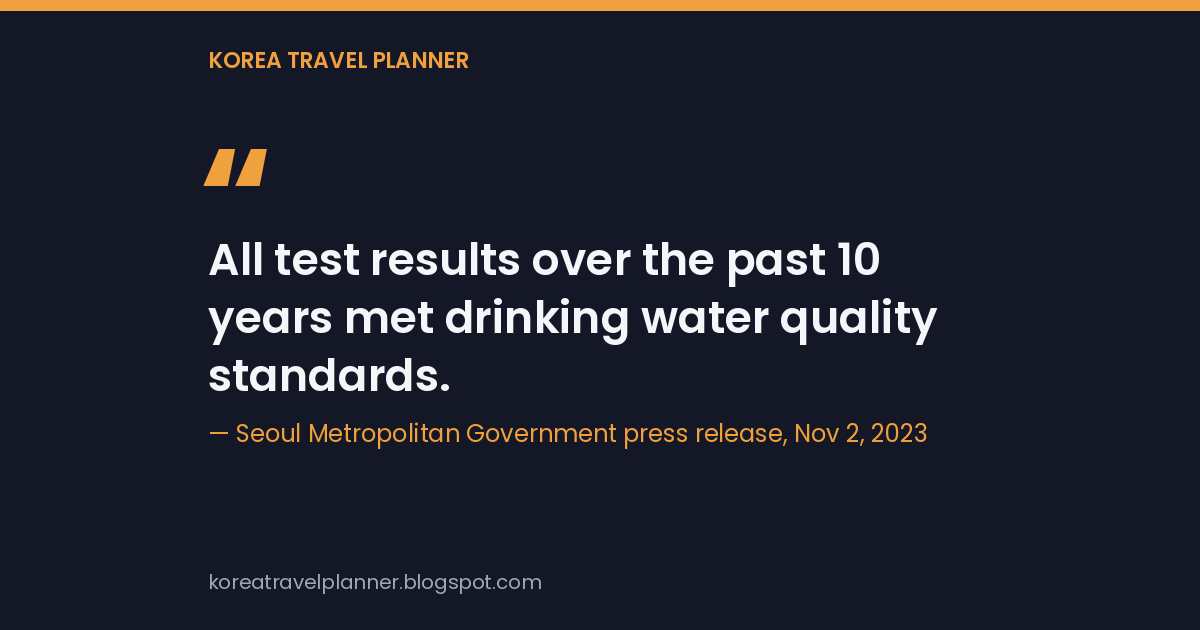
The 2023 release includes this line, in my translation: "All test results over the past 10 years met drinking water quality standards" (최근 10년간 검사 결과는 모두 먹는 물 수질기준에 적합했다). That is a statement about test results measured against a standard. What comes out of one particular tap in one particular building is a separate question, and the release does not take it up.
What households drink
The Ministry of Environment runs a survey called 수돗물 먹는 실태조사, roughly "survey of tap water drinking". The 2024 round was run for the ministry by the Korea Water and Wastewater Works Association, which visited 72,460 sample households between April 22 and June 30, 2024. Of those, 37.9% said they drink tap water, boiled water included. 53.6% use a home purifier. 34.3% buy bottled water. Satisfaction across all sampled households (전체 가구) came to 58.2%, which the ministry splits into 51.4% "somewhat satisfied" and 6.8% "very satisfied" (워터저널, December 6, 2024, quoting the ministry's release).
The first round of the same survey, in 2021, covered 72,460 households across 161 municipalities. Tap drinking was 36%, purifiers 49.5%, bottled water 32.9% (정책브리핑, October 26, 2021). Between the rounds tap drinking rose 1.9 percentage points and purifier use rose 4.1. The two rounds did not ask the same people. 정책브리핑 attributes the 2021 figure, 69.5%, to 수돗물을 먹고 있는 응답자, the respondents who drink tap water, where the 2024 round's 58.2% is 전체 가구. I have not set the two figures against each other.
The 2021 round also asked the people who do drink it why. Convenience 79.3%, cost 76.5%, "I can trust the water quality" 65.6%. Respondents could pick more than one answer, so the figures add past 100.
The reason people give
In the 2024 round, the most-cited reason for not drinking tap water was "I'm worried about impurities from old water pipes" at 34.3%. Then "I don't think it's good for my health" at 21.5%, and "because of the chlorine smell" at 13.2%.
The same survey asked which policy needs strengthening, and the answer changes with how you count. Ranked on first choices only, the top answer is source water quality management at 27.7%, with municipal replacement and cleaning of old pipes second at 22.8%. Count first and second choices together and the order flips. Old municipal pipes come first at 42.5%, then support for replacing and cleaning old pipes inside the home at 38.0%, modernising treatment facilities at 36.1%, source water quality at 35.3%. Korean coverage quotes both sets, sometimes in one article. The 42.5% is the combined-response number.
What you can look up
Seoul runs a free in-home test called 아리수 품질확인제. Staff come to the address and test five items on the spot — residual chlorine, turbidity, pH, iron and copper. If a result comes back non-compliant, the bureau adds seven more items, including a general bacteria count, in a follow-up lab test. The service costs nothing, and bookings go through the 120 Dasan call centre, a district water office, or the bureau's own page.
Between January and June 2026 the bureau logged 3,914 requests, against 1,979 in the same months a year earlier, and reported that none of the 3,914 exceeded drinking water standards (의약일보, June 23, 2026). Evening and weekend slots made up 1,143 of them. A contactless version launched in May 2026 took 621 bookings in roughly its first month.
For a visitor, the limit is that the test goes to a residence, so a hotel guest is not the customer. Anyone can look at the published side. The February announcement says Seoul monitors 556 points across the city in real time and posts key readings every 20 minutes on the bureau's site. The 수도꼭지 수질 page covers tap readings by district. When I opened that page on September 16, 2026, it came up as a clickable map that asks you to pick a district first.
What the sources do not say
None of them tells a visitor to drink it or to avoid it. The item counts are Seoul's own. Busan's waterworks bureau publishes a list of 211 자체검사 items with US, WHO and Japanese standards next to them, and it is not broken out the way Seoul's 362 is into 60 legal, 112 city-monitored and 190 unregulated, so the two totals do not sit side by side. The household survey is national, so its 37.9% is not a Seoul figure. The reason households gave most often for not drinking was old water pipes.
The 362 figure is what Seoul said in February it would reach during 2026, up from the 357 it started the year with. Whether all five additions are in the routine rotation yet is not something that announcement states.
This is a running news series, not a one-off post — new stories go up twice a day, roughly 7am and 7pm Korea time.
More Korea coverage from our network: Hallyu Now · K-Sports Global · Korean Table · Seoul Skin Notes


Comments
Post a Comment