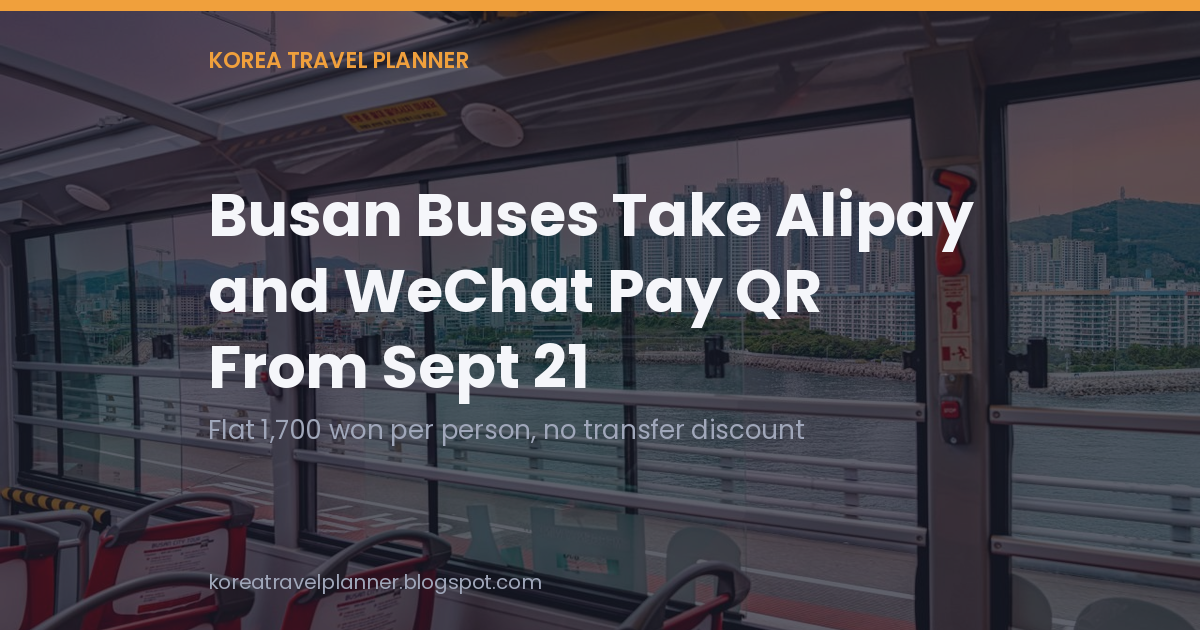
Busan Buses Take Alipay and WeChat Pay QR From Sept 21
Busan city hall said on Tuesday morning (Sept 15, KST) that from September 21 its city buses will take fares through a ZeroPay QR code, so Alipay, WeChat Pay and UnionPay wallets work on board. The city says it is not building a separate bus payment system for this. A ZeroPay QR code is attached inside the bus, the rider opens the wallet app already on the phone, scans it, and the fare comes out of that app. Yonhap carried the announcement at 8:04 am.
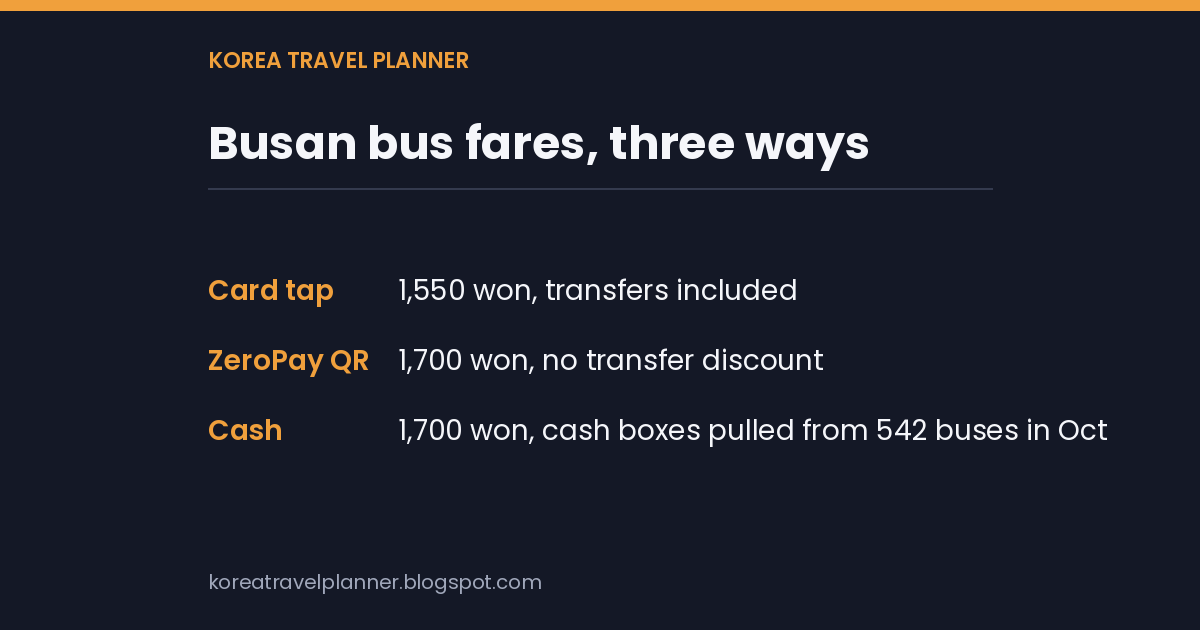
Per person, the fare is ₩1,700 (about US$1.27 / £0.94 at the Sept 14 rate). A group of three scans three times.
The ₩1,700 QR fare next to the ₩1,550 card tap
The city's own wording, in Yonhap's report, is that the QR fare is the "일반 현금 요금", the standard cash fare, applied per head. The same article adds that no transfer discount applies by QR, and that teenagers and children also pay the full ₩1,700.
Compare that with the plastic card. A Busan bus ride on a transit card has cost ₩1,550 since the fare rise of October 6, 2023, per Pressian's report on the increase. A phone scan therefore costs ₩150 more than a card tap on every ride. A tapped card also carries the transfer discount, so a bus-to-subway hop across town is charged once.
One small discrepancy while I was checking the fares. Pressian's 2023 piece said the cash fare would be ₩1,650, card plus ₩100, but the city's figure this week is ₩1,700, and Yonhap prints ₩1,700 as the current cash fare, so I have gone with the city's number. Busan's own fare page would not load for me on Sept 15 (a 503 error on busan.go.kr), so I could not read the official table directly.
Who this is for
With one of those wallets already on the phone, the sequence on a Busan city bus is sticker, scan, sit down, with nothing bought in advance. The city is open about who it has in mind. Yonhap's article says Busan expects more than 4 million foreign visitors this year, and that Asian visitors, China, Taiwan, Hong Kong and the Philippines among them, made up over 60 percent of the total. The three wallets named in the announcement are Alipay, WeChat Pay and UnionPay.
Arriving from the US, UK, Australia or Europe with a Visa in Apple Pay, I could not find anything in either announcement for you. ZeroPay's operator said on Sept 1 that the system is linked to 34 Korean apps and 76 overseas apps from 24 countries, in an edaily report on a separate deal with Busan's restaurant association. Which 76, it does not say. ZeroPay's own "usable apps" page (in the Sources line) rendered for me as "0 domestic payment apps, 0 overseas payment apps", a script that never loaded.
For a Western traveller, then, Sept 21 changes nothing. Buy a T-money card at the first convenience store you see. We ran the numbers on T-money last week. The card costs ₩2,500 to ₩4,000, and at ₩150 saved per ride it pays for itself in 17 to 27 rides, sooner with one transfer a day.

Cash boxes come off 542 buses in October
Ten days after the QR stickers go up, Busan starts pulling cash boxes off buses. Ajunews reported on Aug 31 that from October the city will run a three-month "cashless bus" pilot on 35 routes and 542 vehicles, about 20 percent of the fleet. The stated reason is cost. Cash boarding has fallen to around 1 percent of rides, and the city puts the annual cost of maintaining the cash boxes at roughly ₩1 billion. Daegu ran the same experiment earlier and, per the same article, its cash share dropped from the 2 percent range to about 0.1 percent.
Taken together, the two announcements set out this sequence. From Sept 21, a phone wallet is one of three ways to pay. From October, on about one bus in five, it is one of two, because the cash option disappears on those routes and the fallback for someone with no card is a bank transfer to the account given on the notice, which is not realistic for a visitor without a Korean bank app. The ajunews piece says the pilot buses will let cash-holding passengers board anyway and will not chase the unpaid fare. That covers October to December; what happens on those routes from January, I could not find.
Neither article says so, but my reading of the two dates is that the QR launch is groundwork for a fleet with no cash box at all.
What to do with this on the ground
The QR code is attached inside the bus from Sept 21, and a wallet that isn't on ZeroPay's list has nothing to pay with there. Check which of your apps is linked before you board. The list of 76 is the page I could not get to load.
Four T-money cards are a nuisance to buy, and over a week of buses and subways they still come out cheaper. On the QR route a family of four pays ₩6,800 (about $5) for one bus, since every child is ₩1,700 too.
A T-money card bought in Seoul works on Busan buses as well (Wikipedia's T-money entry lists the cities it covers), so a KTX day-tripper from Seoul taps the same card here and pays the same ₩1,550.
The bit I would like to know and couldn't find is whether the QR fare shows up in the wallet as ₩1,700 or as a converted amount with a foreign-exchange margin on top, because that would decide whether the ₩150 gap is really ₩150. If you ride one of these buses after the 21st and pay through Alipay or WeChat, the receipt screenshot is the one thing I'd ask you to post below.
Sources: Yonhap via Daum, Sept 15, 2026 · Pressian, Aug 18, 2023 · Ajunews, Aug 31, 2026 · edaily, Sept 1, 2026 · ZeroPay usable-apps page · exchange rate from open.er-api.com, Sept 14, 2026 (₩1,342.6 per US$)
This is a running news series, not a one-off post — new stories go up twice a day, roughly 7am and 7pm Korea time.
More Korea coverage from our network: Hallyu Now · K-Sports Global · Korean Table · Seoul Skin Notes


Comments
Post a Comment