Incheon Airport's Chuseok Crush Splits Across Two Days
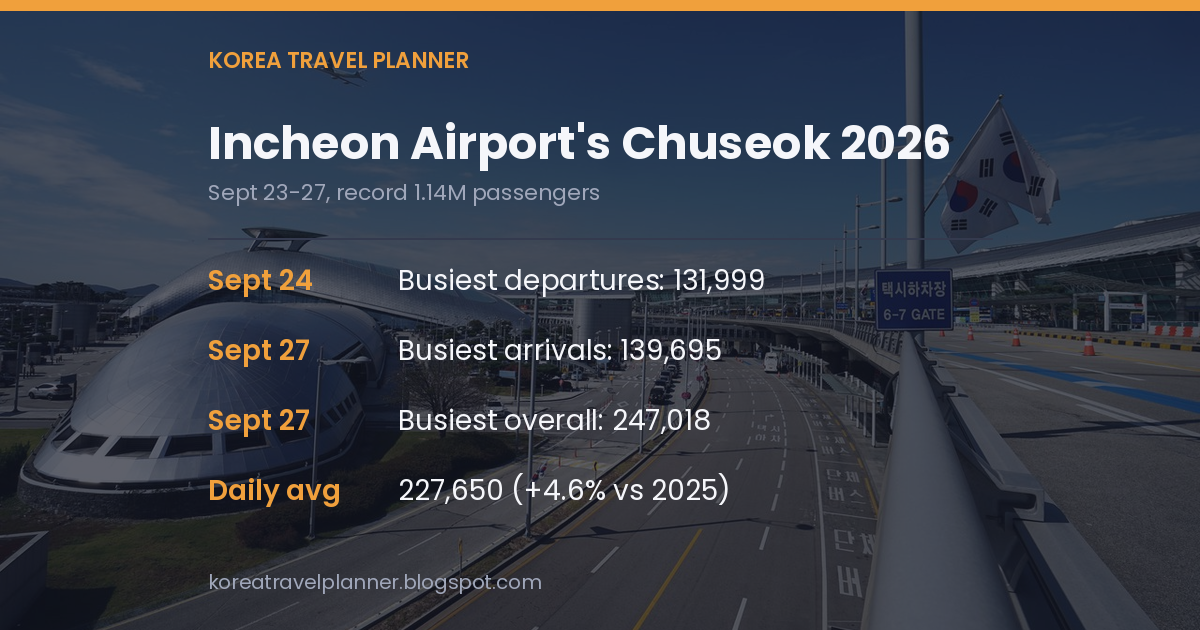
Incheon International Airport expects 1.14 million passengers over five days this Chuseok. That works out to 227,650 a day, the highest daily average the airport has logged for this holiday, up 4.6% from last year's 217,614, according to numbers the airport operator released on September 22 (fnnews.com).
These five days run September 23 through 27, wrapping around Chuseok's own holiday dates of the 24th through the 26th. Two single days carry most of the crowd, September 24 and September 27, sitting on opposite ends of the trip.
The Two Days That Actually Matter
September 24 is the worst day to depart. Some 131,999 passengers are expected to fly out of Incheon that day, more than any other day in the five-day window (fnnews.com). Everyone leaving Korea itself, or connecting onward from Seoul, is booked to travel on that same first full day of the holiday.
September 27 runs the opposite direction. Arrivals peak that Sunday at 139,695, the most of any day in the window (fnnews.com). Chuseok gets no substitute Monday this year, so everyone flying back has to clear the airport before Monday turns into a normal workday again.
Its arrivals and departures together make September 27 the single busiest day overall, 247,018 people through the airport in one day (newsworks.co.kr).
If you can shift a booking, avoid flying out on the 24th. Flying in, the 27th is when the terminal is fullest, both arrivals and departures at once.
What Changes at the Gates
The airport isn't only publishing numbers. In cooperation with the justice ministry, the departure gates that see the heaviest morning traffic open 30 minutes earlier than usual for the stretch, aimed at the morning departure crowd (newsworks.co.kr). The report doesn't name which specific gates, so if you're departing early, confirm your own gate's hours at the terminal rather than assuming a particular one is affected.
Staffing goes up to match. Security adds 25 screeners. Ground staff nearly double, from 47 to 83, plus 34 more people assigned specifically to self-service kiosks. Self-check-in now covers 24 airlines, four more than before, and self-bag-drop covers 13, three more. On September 24, the worst departure day, the airport plans to run up to 45 CT X-ray scanners for security screening at once (newsworks.co.kr). An AI tool that estimates how long departure procedures will take is also expanding to Terminal 2 this holiday, feeding results into portal apps like Naver.
What the Airport Actually Tells You to Do
The recommendation from the airport operator itself is blunt. Get to the airport three hours before your flight (fnnews.com). On an ordinary Tuesday, most travelers would treat that as padding. On September 24 or 27, three hours is not overcautious advice; the corporation is saying, through its own staffing and X-ray numbers, exactly when it expects the queue to form. A 9 a.m. departure on the 24th means being at security by 6 a.m. to keep that buffer.
Departing on the 24th, check whether your own gate is one of the ones opening early before you plan your morning around a standard check-in time — the airport hasn't published which gates, so this is worth confirming directly rather than guessing.
Arriving passengers skip the departure security lanes above entirely. What actually slows an arrival down on the 27th is immigration and baggage claim. Build slack into whatever transfer or pickup comes after landing.
Korean coverage of this year's numbers doesn't break the day down hour by hour beyond the general early-gate-opening notice and the three-hour advice. For a live read before leaving for the airport, check the AI wait-time estimator rolling out to Terminal 2.
Tourists landing rather than flying out to see family aren't really who the extra staffing is sized for. It's built for holiday volume overall. What changes for a visiting traveler is narrower. The immigration line on arrival and the taxi or AREX queue right behind it both run slower exactly when the arrivals figure above says they will.
Getting There by Car
Anyone reaching Incheon by car rather than AREX or a bus gets one change. The toll on Cheongna Sky Bridge, the newest of the three road links onto Yeongjong Island where the airport sits, drops to zero for four days. Incheon's economic zone authority is waiving it from midnight on the 24th through midnight on the 27th, for every car regardless of where it's registered, including cars from outside Incheon (fnnews.com).
The bridge only opened this January as Incheon's third direct link onto Yeongjong Island, alongside the two older bridges. Check whether a navigation app is already routing through it before setting off.
Most arrivals use AREX or an airport bus, and nothing in this year's Chuseok measures touches either one. The crowding above happens inside the terminal. Getting to Incheon itself isn't part of the problem this year.
Which end of this are you on, flying out on the 24th, or flying back in on the 27th?
This is a running series, not a one-off post — a new post goes up every day, at around 5pm Korea time.
About · Contact · Privacy Policy
Read next: Incheon Airport Smart Pass: Set It Up Before Chuseok Crowds Hit · Incheon Airport's New Sunflower Lanyard Needs No Proof · Chuseok 2026 in Seoul: Last Trains Run Until 1 AM, Not 2
You might also like: What Koreans Eat on Chuseok: Songpyeon, Jeon, the Flour Mistake (Korean Table)


Comments
Post a Comment