Chuseok 2026 in Seoul: Last Trains Run Until 1 AM, Not 2
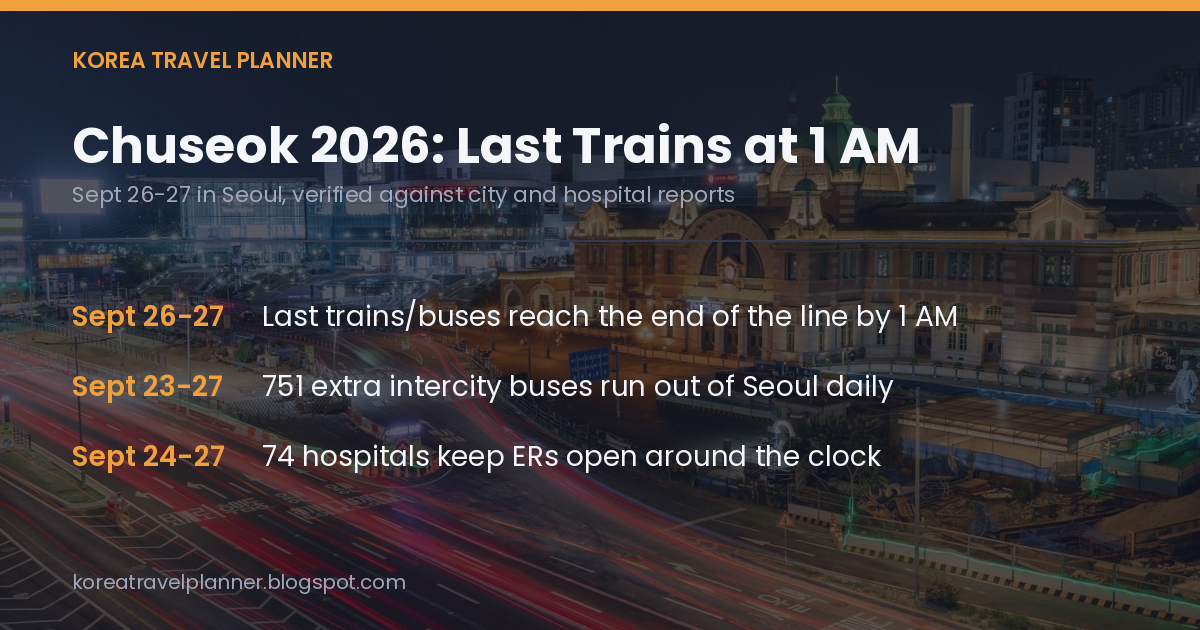
Seoul's last subway trains and buses during Chuseok 2026 will reach the end of the line by 1 a.m. That's an hour earlier than the 2 a.m. cutoff the city used the last time this holiday needed the same fix. If you're flying home through Incheon or catching a KTX out of Seoul Station on September 26 or 27, that hour matters more than it sounds like it should.
Why the Crush Lands on Exactly Two Nights
Chuseok's legal holiday runs Thursday the 24th through Saturday the 26th this year. Sunday the 27th tacks on for free since it's already a weekend day. There's no substitute Monday; that only kicks in when the holiday lands on a Sunday, and this one doesn't (publicholidays.co.kr). Monday the 28th is a normal workday, offices open, kids back in school.
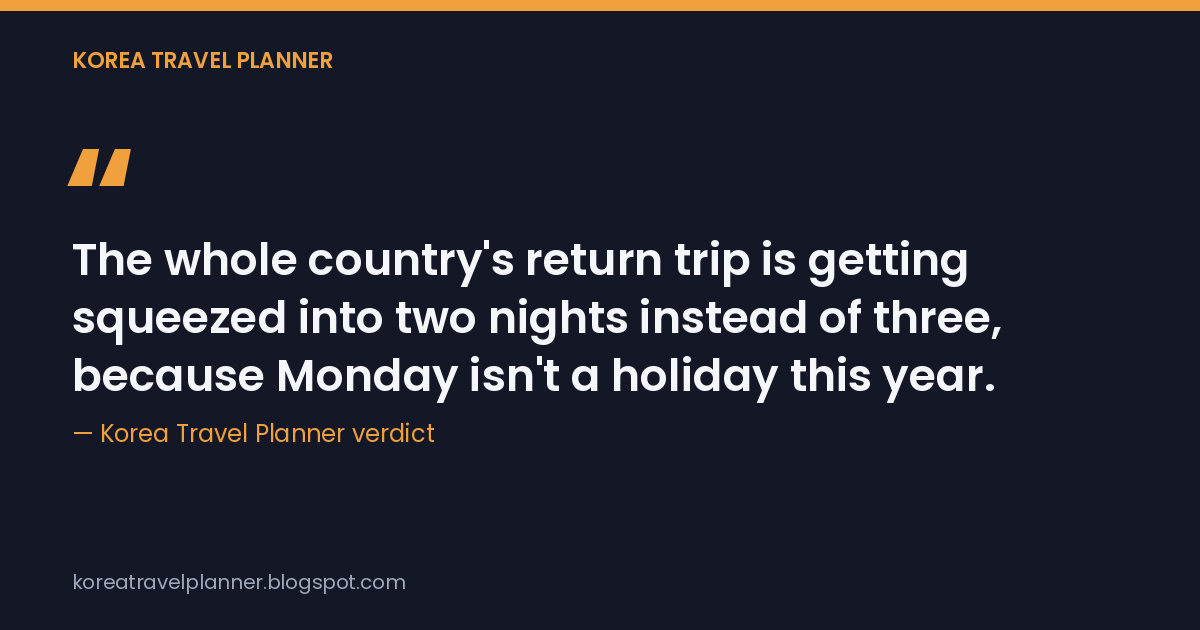
Everyone who left Seoul on the 24th has to be back by Sunday night, since the holiday doesn't add a substitute Monday this year. Return traffic that would normally spread across three evenings gets pushed into two instead. Seoul's transit authority built its extended-hours plan around exactly that math, according to Kyunghyang Shinmun's report on the city's Chuseok measures, published the same day I'm writing this.
What Extends, and Until When
On the nights of September 26 and 27, subway lines 1 through 8's Seoul Metro segment, Line 9, the Ui-Sinseol Line, and the Sillim Line all run late enough that the last train reaches its terminus by 1 a.m. instead of stopping service at the usual time. Buses serving Seoul Station, Yongsan, Yeongdeungpo, Cheongnyangni, and Suseo, plus Seoul Express, Dongseoul, and Nambu terminals, get the same treatment. Add it up and the two nights combine for 128 extra subway runs, 64 a day.
Chuseok also needed this fix in 2024. Buses and trains ran until 2 a.m. that year, per Korea JoongAng Daily's coverage at the time, with subway trips increased by 121 runs a day, according to Kyunghyang Shinmun's report from that Chuseok. This year's window is an hour shorter but carries more runs — more traffic packed into fewer hours. Don't plan a 1:30 a.m. subway ride back from Hongdae on the 26th or 27th.
That train already left.
AREX, the airport rail link between Incheon and Seoul Station, doesn't show up in either the Kyunghyang Shinmun or Korea Duty Free News reporting on the extended list, so treat its normal last-train time as final on those two nights. Landing after midnight on the 26th or 27th, budget for a taxi from the airport rather than assuming the train will still be running when you clear immigration.
The Highway Side: 751 Extra Buses a Day

If your trip involves an intercity bus rather than the subway, the bigger number is on the highways. From September 23 through 27, Seoul runs 751 additional express and intercity bus departures every day, moving roughly 25,000 more passengers than a normal day, figures that show up consistently across Kyunghyang Shinmun and Korea Duty Free News's report on the same city announcement. A bus that might run every 20 minutes on a regular Saturday is running closer to every 15 through that five-day window.
It's fine to just book a hotel near Seoul Station for the 26th instead of gambling on a smooth return trip that night. Plenty of visitors skip the last bus altogether and book one extra night's accommodation instead. Nobody's grading you on toughing it out.
If your dates are flexible at all, moving your Seoul-bound leg to the 25th (Chuseok day itself) instead of the 26th or 27th sidesteps the whole squeeze. Korail's advance-reservation window for the September 23–27 travel period already closed on the 11th, so at this point don't expect to book a seated KTX ticket for the return days cold. Standing tickets and last-minute cancellations still move through the Korail app right up to departure, and SRT, the competing high-speed line out of Suseo, runs its own separate booking system with its own leftovers.
If You Need a Doctor While Everyone Else Is Traveling
Seoul keeps 74 emergency facilities open around the clock through the holiday, a mix of 51 designated emergency medical institutions and 23 general hospitals running their own ERs, a split confirmed in the same Kyunghyang Shinmun report. If you're traveling with kids, 8 of those are designated "우리아이 안심병원" (child-safe hospitals) with 3 more counted as pediatric emergency centers, so pediatric ER capacity specifically isn't an afterthought this holiday.
I haven't found an English-language list naming which 74 hospitals those are, so I can't hand you specific addresses here. The Korean articles report the count. They don't list the roster. Your travel insurance provider's Korea hotline, or the front desk of wherever you're staying, is the faster route to an actual address at 2 a.m. than trying to translate a government PDF on your phone.
Walk past Seoul Station on either of those two nights and you'll hear it before you see it. Terminal announcements run back-to-back in Korean, Mandarin, and English, competing with the low rumble of idling buses out front. It's the one week of the year the station sounds busier at midnight than at noon.
None of this changes anything if your trip lands outside September 26–27. But if your flight home or your last KTX happens to fall on one of those two nights, build in the extra hour you'd otherwise lose assuming last service runs to 2 a.m. like it used to. Book the earlier train if you can. The later one exists; it just ends sooner than you'd guess.
This is a running series, not a one-off post — a new post goes up every day, at around 5pm Korea time.
About · Contact · Privacy Policy
Read next: Incheon Airport's Chuseok Crush Splits Across Two Days · Air Premia's Chuseok Sale Puts Korea Flights at $661 · Do You Need Travel Insurance for Korea? What an ER Visit Costs
You might also like: What Koreans Eat on Chuseok: Songpyeon, Jeon, the Flour Mistake (Korean Table)


Comments
Post a Comment