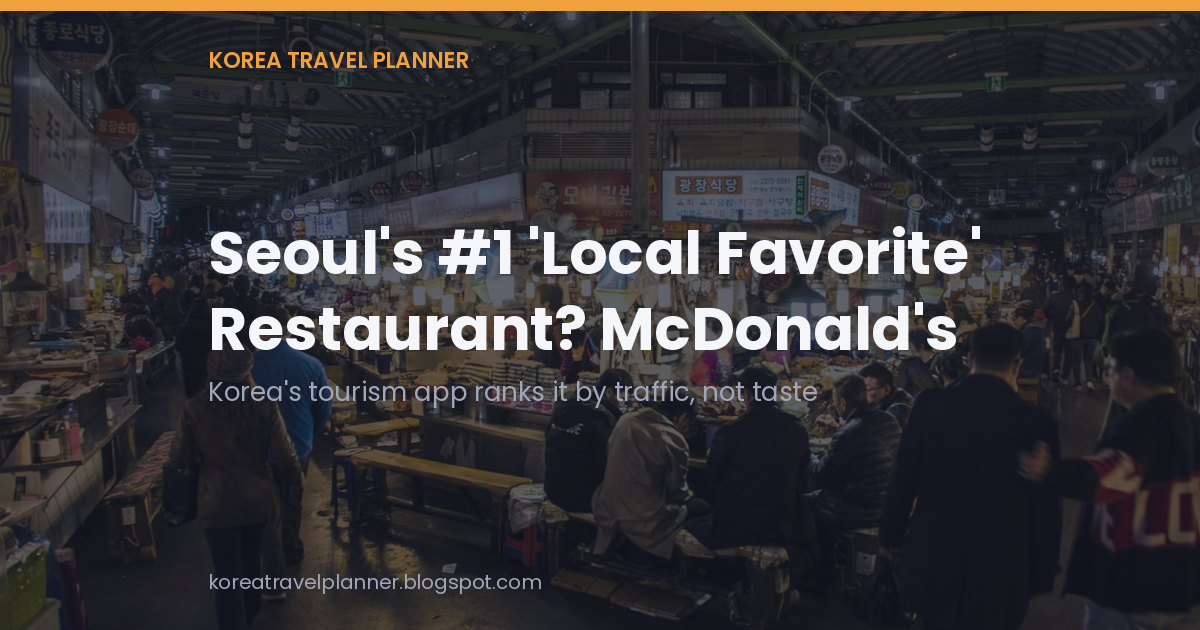
Seoul's #1 'Local Favorite' Restaurant? McDonald's
Open Korea's official local-food chart for Seoul right now, and the No. 1 pick under "locals' favorites" is a McDonald's drive-through in Samsung-dong.
That's not a glitch from a slow news day. The ranking lives inside 대한민국 구석구석 (Korea's "Every Corner"), the Korea Tourism Organization's own domestic travel portal, at korean.visitkorea.or.kr. When I opened the chart myself, the same result Korean papers were reporting that afternoon was still live. McDonald's Samsung DT branch (DT is Korean fast-food shorthand for drive-through) held first place under "현지인" (locals), and three more McDonald's drive-throughs filled out the city's top six: Songpa Jamsil DT, Deungchon DT, and Seoul Dungchon DT.
How a Government Tourism App Ends Up Recommending a Drive-Through
The chart isn't measuring how good the food is. It isn't measuring food at all. It runs entirely on Tmap navigation logs: anyone who searches for a restaurant as a destination, then drives for at least one minute and covers at least 100 meters toward it, counts as one visit toward that restaurant's score (Asia Economy Daily, reported September 23). Ratings, repeat customers, and how distinctive a dish is don't enter the count. The chart updates once a month, on the 8th.
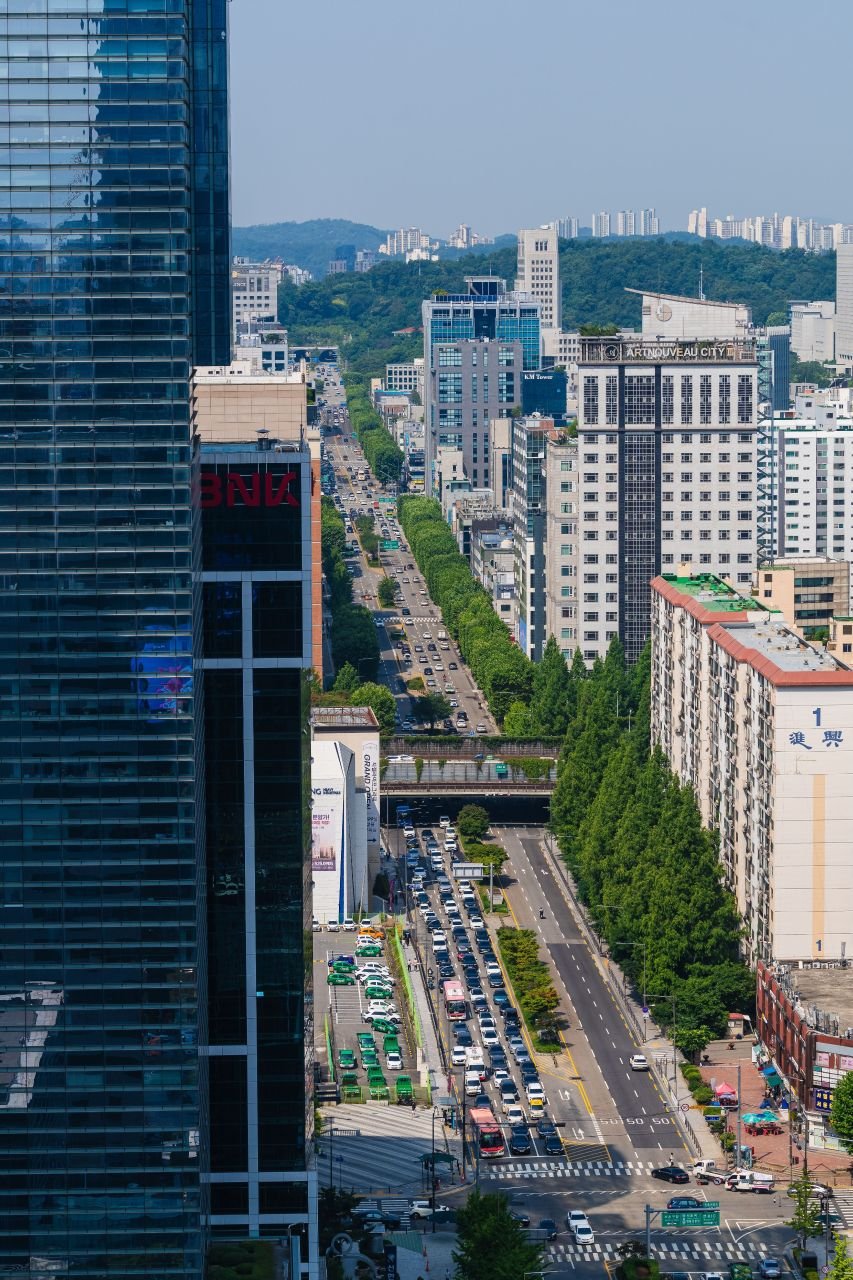
Samsung-dong sits right on Gangnam-daero, one of Seoul's heaviest commercial corridors, the kind of road where an office worker can search for a restaurant, drive over, and pull straight up to a drive-through window without ever getting out of the car. A noodle shop down a narrow alley can't rack up navigation "visits" the same way, no matter how good the noodles are. Neither news report breaks down how many of the McDonald's trips were an actual meal stop versus someone grabbing coffee between meetings.
Seoul isn't even the extreme case. In Ulsan, the same chart puts McDonald's in three of its top six spots: the Hogye SK branch at No. 3, Samsan at No. 4, and Samsan-ro at No. 6 (Asia Economy Daily, September 23).
A Lawmaker Called It Out, and the Tourism Office Agrees
This isn't some obscure corner of a government site nobody checks. The portal logs tens of millions of visits a year: about 46.94 million in 2024, 55.97 million in 2025, and roughly 39.6 million already through August of this year, according to figures a lawmaker's office pulled from the agency (Tax & Finance News, September 23).
That scale is what forced the question into the open. Rep. Choi Min-hee, who sits on the National Assembly's Culture, Sports and Tourism Committee and represents Namyangju A, put it plainly: "A restaurant with heavy navigation traffic and the area's signature restaurant for tourists are clearly two different things." She's pushing the tourism organization to add filters for a place's distinctiveness and real user preference, not just how many cars drove there (Tax & Finance News; Asia Economy Daily, September 23).
The tourism organization isn't really disputing it. Its own response, relayed in the same reporting, is that the current method "can diverge from the kind of representative or distinctive restaurant recommendations tourists expect." That's an admission, not a defense of the method.
What This Means for Planning Your Next Meal
Before you screenshot this chart as proof of where to eat, one thing is worth knowing. It isn't built for a foreign visitor in the first place. The site is Korean-language only, aimed at Korean travelers checking out somewhere else in their own country. I checked the KTO's separate English portal, english.visitkorea.or.kr, in its "Food" menu and through its own search box for this chart's name; neither turned up anything past a general dining write-up.
The flaw still travels past the site's own borders. Any list built from where a navigation app sends the most cars favors whatever has a drive-through and curbside parking. Taste doesn't factor into that math. This particular Korean government chart runs on it, and so does any English-language "best local eats" roundup built on foot traffic or check-ins instead of what people actually ordered.
Switching the filter to "외지인" (visitors from elsewhere) doesn't fix it either. Seoul's current No. 1 in that column, when I checked, was a Starbucks branch near Bukhansan, popular for the mountain view more than the espresso. The logic is the same, the chain result is the same. Only the reason people show up changes.
If you want to eat where people line up on purpose, this particular chart isn't the shortcut. A place like Gwangjang Market in Jongno still draws the kind of crowd Tmap's method can't count: people park once, then walk between a dozen food stalls, with no single destination search logged for any of them. On Naver Map, a high review count with real photos for one specific dish is a better signal most days. Whoever runs your guesthouse probably has a better answer than either one.
The chart isn't wrong on its own terms. It's counting something real: how many cars pull off Gangnam-daero into one drive-through. As a fact about Seoul traffic, that's mildly interesting. As a guide to where to eat, skip it.
Has a "locals' favorite" app ever pointed you straight at a chain back home?
This is a running series, not a one-off post — a new post goes up every day, at around 5pm Korea time.
About · Contact · Privacy Policy
Read next: Incheon Airport's Chuseok Crush Splits Across Two Days · Seoul Light Festival 2026: Nodeul Island Hours and Fares · KTX Booking Opens Two Months Ahead From October 1


Comments
Post a Comment